The Feasibility Gap in Zero-Emission Road Freight
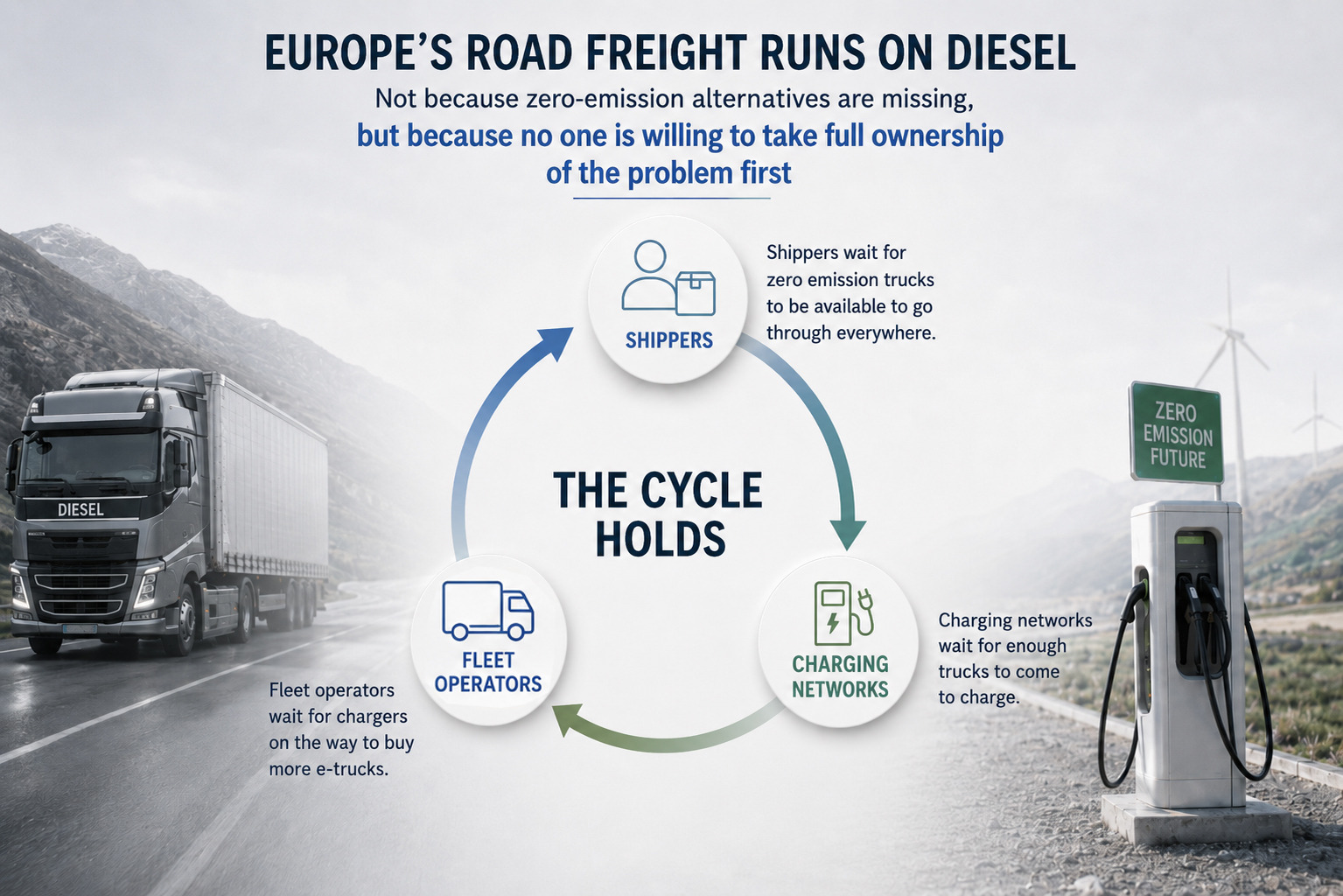
Europe’s road freight still runs on diesel not because zero-emission alternatives are missing, but because no one is willing to take full ownership of the transition first.
Shippers wait for zero-emission trucks to be able to move reliably across routes and borders. Fleet operators wait for charging infrastructure to be present before scaling electric truck purchases. Charging networks wait for enough trucks to be on the road before committing capital. Investors wait for the cycle to break and for the market to prove that it can scale with acceptable returns.
The result is a loop that keeps holding. Every stakeholder can point to a dependency that must move first, and the market stalls even when the technology direction is already clear.
In simple terms, this is a chicken-and-egg problem. In professional terms, it is a feasibility gap: a gap between technical possibility and coordinated market delivery.
This is exactly why stakeholder coordination matters. Demand, fleets, charging infrastructure, finance, and policy cannot move in isolation if Europe wants real zero-emission freight corridors rather than fragmented pilots.