Online roundtable - Vienna / CET
This is a working session for the stakeholders who actually make that happen.
Description
The goal
Seamless high-power truck charging Infrastructure from North to South from East to West
The problem
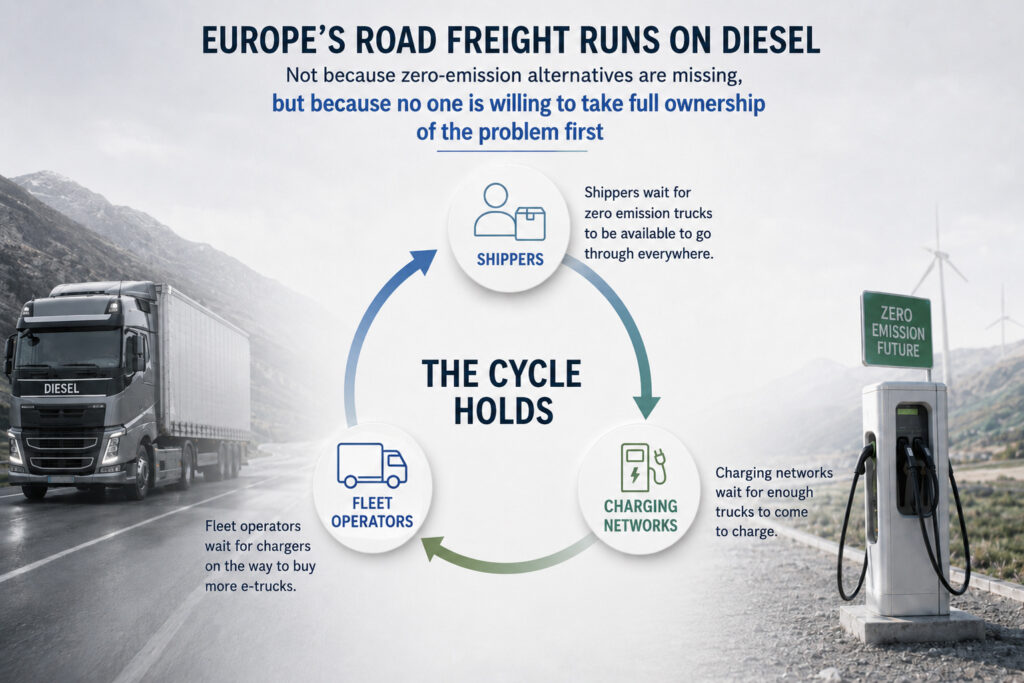
Europe's road freight runs on diesel - not because zero-emission alternatives are missing, but because no one commits first.
Shippers wait for zero emission trucks to be available to go through everywhere. Fleet operators wait for chargers on the way to buy more e-trucks. Charging networks wait for enough trucks to come to charge. The cycle holds. Investors wait for the loop to break and the system scales, so the ROI is there. It’s a chicken-and-egg problem in popular language or, in a professional language, it’s a feasibility gap.
The solution
Road freight will not decarbonize organically - unlike passenger cars. It requires coordinated action across industries, governments, and investors simultaneously, along all the thousands of kilometers of the European roads. The demand commitments for zero emission freight operation, the sustainable fleets, powering infrastructure, and the digital layer must move forward together.
The gap to be closed through collaboration together, to align the approaches, call for public support mechanisms, to get financed timely and to break through the issue, stronger, forward.
This roundtable is designed to break the loop
Registration
Request your seat below
The Agenda
Big Picture
Net Zero Freight - EU Sovereignty and Resilience: the way out of the oil supply crisis?
Looking at the puzzle - what is there and what is still missing?
Goals and milestones
Alignment of interests
Funding and Investments
Cross-border collaboration and joint action
Meeting the regulations
Practical regulatory needs
Demand. Switching to ZE freight
Formal commitment to preference for zero emission freight transportation
Setting predictable (tentative) amounts of demand of use on specific directions/routes. Matching and exceeding costs. Connecting Net Zero freight commitments to sustainability reporting
Fleets and Transportation
Why logistical operators don't buy electric trucks in overwhelming quantities?
Why do we fail the fast and total transition?
Projected need in fleets to meet the transportation demand
Projected fleet market availability, supply and purchase
Intermodality collaborations:
Connections to rail
Connections to ferries
Connections to marine and inland waterways
Infrastructure and Energy
Effective cross-border coordination
Routing the corridors where they make the most of impact
Charging network geospatial architecture
Designs: efficient and resilient
Equipment and Components
Engineering and Installation
Local Renewable Energy and Energy Storage
Location planning and infrastructure restrictions
Property issues (for charging infrastructure)
Aesthetic issues of charging infrastructure
Digital. IT Solutions and Infrastructure
Funding and Financing Opportunities
IFI and Bank products
EU, National and Regional support Programs
Cross-border projects
"Single Window" funding concepts
At the end of each roundtable session, conclusions are consolidated into a final resolution for publication.
Who should be in the room
01
Shippers from trade and industry who set sustainable goals for transport footprint, fleet companies
02
Transport companies and logistics operators scaling fleets of ZE trucks
03
CPOs and charging infrastructure developers
04
EU and national policy advisors on heavy mobility
05
Infrastructure and climate-tech investors
06
Energy companies and grid operators
When & Where
Day
Time
Location
Tickets and approvals
Free
Paid
349 EUR
About CorridorToZero.EU
The corridor
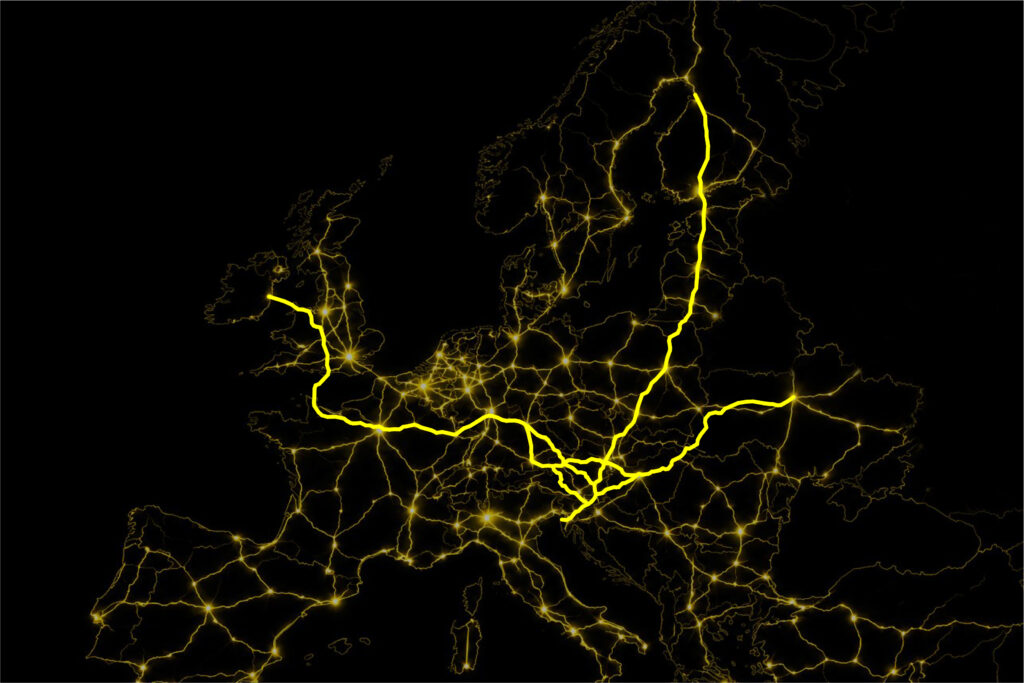
Two corridors forming a cross over the European sub-continent, intersecting in Austria. North to South. West to East. Together they cover 10+ countries and connect the North Sea, the Baltic, the Black Sea, and the Adriatic - the backbone of seamless, high-power zero-emission road freight and passenger infrastructure for Europe.
Corridor route map
The main problem
Extremely low pace of decarbonisation in road freight transportation. Without serious joint efforts from stakeholders, government, and industry, the road freight sector transition to Net Zero will not occur on time.
The problems behind
B2B customers are ordering road freight transportation performed by default with combustion-engine trucks, because this remains the main, and in most locations the only, kind of transport supported by available infrastructure.
There is still no commitment to purchase zero-emission transportation services to replace fossil-backed ones, rooted in the absence of widely accessible offers and unclear perspectives on when this will change.
There are no fleets capable of transporting goods across long distances without creating carbon emissions at the required scale, which means businesses still cannot reliably hire decarbonised transport within present European infrastructure.
Transport companies have little motivation to buy or rent zero-emission trucks because demand commitments are weak and charging at the right power, in the right place, at the right time, is still not guaranteed.
There is a lack of 350+ kW and MW chargers for trucks across almost all TEN-T identified roads in Europe, and no sufficiently intensive build-out to catalyse decarbonised freight transport at scale.
There is no intensive building of 350+ kW and MW infrastructure sufficient to catalyse the ability of European decarbonised truck transport to serve customers.
Demand for charging fleets is still too limited to make 350+ kW and MW transport infrastructure emerge organically, because the capacity would sit idle and remain uneconomic for too long without enough existing trucks to use it.
There is no scale of platforms dedicated to resolving the coordination, measurement, and operational gaps of zero-emission freight connectivity.
Cars had some success with organic decarbonisation because people purchased electric vehicles and home chargers together. Truck decarbonisation will not spread with the same organic success because the economics, infrastructure needs, and operational constraints are fundamentally different.
Governments need to evolve their awareness and structuring of the heavy mobility problem and policies.
Goals
Our approach
The approach to how we build the corridor is different. Europe is so diverse that along the way there are hundreds of interests and opinions, hundreds of stakeholders, hundreds of community needs, hundreds of talents with invaluable local knowledge, and hundreds of businesses that can become part of making the change.
Empowering stakeholders means leveraging what is already in place and making things work with the highest possible precision to local conditions and demand. The efficiency and the strength of outcomes should be backed by diversity, not hindered by it, even when the corridor itself is one long unified system by its technical nature.
Seeing the similar tops of the trees from a train window, we usually do not keep in mind how different they are underground in their local conditions. The same is true when aiming for the similar result in different locations: the roots differ.
How do we do that?
Join the initiative
If you want to participate as a partner, stakeholder, supporter, or contributor to the initiative, send a short message to the organising team.
Register
14:00 - 18:00 CET | Online.
If you prefer direct contact: my@corridortozero.eu
Team
A small core team coordinating stakeholder alignment, collaboration on routing and deployment across the initiative
Coordinator
Austria
Stakeholders empowerment. Corridor ecosystem functional and geospatial architecture.
Coordinator
Austria
International economic relations and cross-border collaboration. Sustainability impact.
Coordinator
Ukraine
Sustainable development and environmental economics. Policy, education and implementation pathways.
Coordinator
Communications, media and events.
Coordinator
Ukraine
Transport infrastructure research, economy and planning. Collaboration non-EU and Ukraine routes.
Organiser
Technical organisation by GNerdiX OÜ, Estonia.
Register No: 12933228
VAT No: EE101910280
Address: Narva mnt 5, Kesklinn district, Tallinn, Harju county, 10117, Estonia
Website: https://gnerdix.com/